
~日本のヒイラギと西洋ヒイラギ、その違いとトゲの秘密~
日本で「ヒイラギ」と聞くと、イングリッシュホーリーも西洋ホーリーも、まとめて同じものとして扱われがちです。でも実は、日本のヒイラギと西洋のヒイラギは、そもそも別の植物です。
いわゆる日本のヒイラギは、金木犀と同じモクセイ科に属し、実も黒っぽい色をしています。一方、西洋ヒイラギ(イングリッシュホーリーなど)は、もちの木科。科のレベルで違う、まったくの別種なのです。
日本では昔から、家の庭の表鬼門(北東)にヒイラギ、裏鬼門(南西)にナンテンを植えると良いとされてきました。いわゆる鬼門除けですね。また、節分の夜にヒイラギの枝に鰯の頭を刺して門戸に飾る「柊鰯(ひいらぎいわし)」という風習も、全国的に見られます。「鰯の頭も信心から」という言葉も、ここから来ています。
実は学生の頃、住んでいたアパートでこの光景に出くわしたことがあります。干からびた魚にヒイラギが刺さったものが、表階段に取り付けられていて、見るたびに正直怖くて……。何か変な宗教か、黒魔術的なものだとばかり思い、その家の人を無意識に避けてしまっていました。この風習の意味を知ったのは、ずいぶん後になってから。今思うと、隣人にとても失礼なことをしてしまいました😓
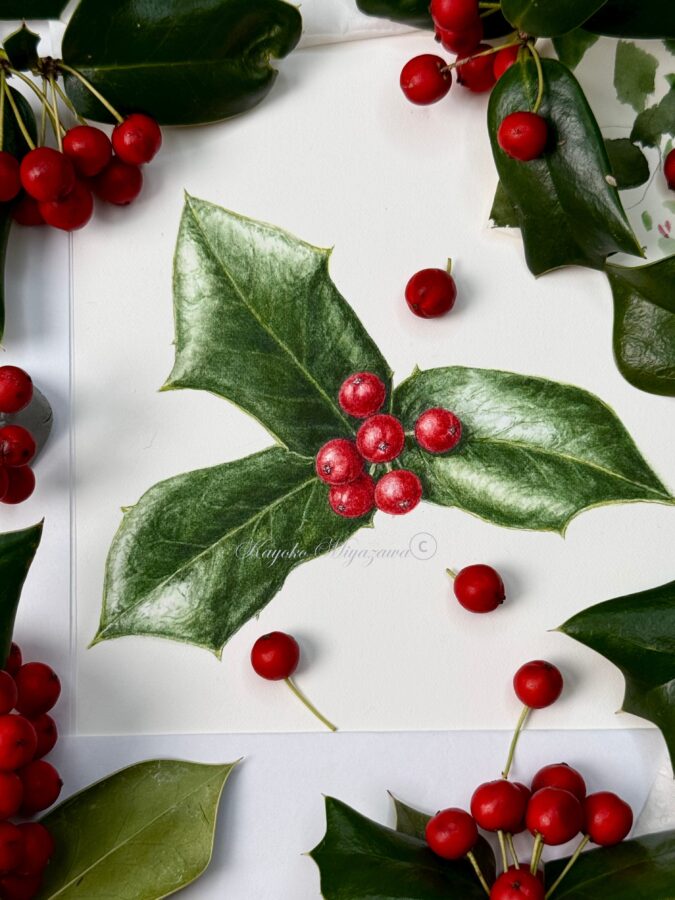
植物としての見分け方も、実ははっきりしています。日本のヒイラギは葉が「対生」するのに対し、セイヨウヒイラギは「互生」。この違いだけでも判別が可能です。
イングリッシュホーリーといえば、あの鋭くギザギザした葉がとても印象的で、本当に美しい植物です。ただ、日本、少なくとも東京では、あの典型的な姿のものを見かけることはほとんどありません。緯度の近い北海道にはあるのでしょうか……少し気になるところです。
東京あたりで手に入るヒイラギの多くは、西洋ヒイラギではあるものの、葉の形は丸みがあり、トゲも控えめなタイプがほとんどです。
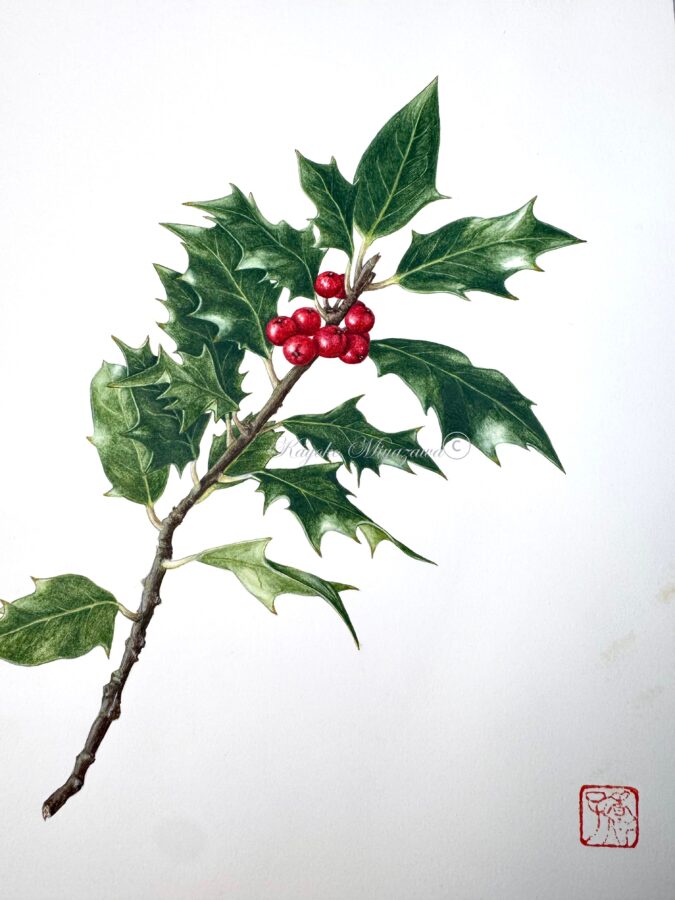
今回、私が描いたヒイラギも西洋ヒイラギ。観察していて気づいたのは、下の方の葉にはトゲが多く、上の方の葉になるほど丸くなり、トゲが少なくなっていることでした。調べてみると、下の葉は虫に食われやすいため、防御としてトゲが発達し、虫が届きにくい上の葉にはトゲが出にくくなるのだそうです。
なんて面白い現象なんでしょう。
植物は、こうして環境に適応しながら進化してきたのですね。
知れば知るほど、描く対象としての植物が、ますます魅力的に見えてきます。
宮澤 香代子
— Japanese vs. Western Holly : The Differences and the Secret of the Thorns
In Japan, when people hear the word “Hiiragi” (Holly), they tend to lump English Holly and Western Holly together as the same thing. However, Japanese Hiiragi and Western Holly are actually entirely different plants.
The so-called Japanese Hiiragi belongs to the Oleaceae (Olive) family, the same as the fragrant olive (Kinmokusei), and it bears blackish berries. On the other hand, Western Holly (such as English Holly) belongs to the Aquifoliaceae family. They differ even at the family level and are completely distinct species.
In Japan, it has long been believed that planting Hiiragi in the front “demon’s gate” (the northeast) and Nanten (Sacred Bamboo) in the back “demon’s gate” (the southwest) of a house brings good luck. This is known as Kimon-yoke, or protection against evil spirits. There is also a custom seen nationwide called “Hiiragi Iwashi,” where a sardine head is stuck onto a branch of Hiiragi and displayed at the entrance on the night of Setsubun (the day before the beginning of spring). The proverb “Even the head of a sardine can be a god if you have faith” (meaning belief is everything) comes from this tradition.
To be honest, I actually encountered this sight at an apartment where I lived when I was a student. A dried-up fish impaled on a branch of Hiiragi was attached to the front staircase. Every time I saw it, I was genuinely scared… I assumed it was some strange cult or black magic, and I unconsciously avoided the people living in that unit. It wasn’t until much later that I learned the meaning of this custom. Thinking back now, I realized I had been very rude to my neighbor. 😓
Botanically, the method of distinguishing them is actually quite clear. Japanese Hiiragi leaves grow “opposite” (in pairs), whereas Western Holly leaves grow “alternate” (staggered). You can identify them just by this difference alone.
When we think of English Holly, those sharp, jagged leaves make a strong impression; it is a truly beautiful plant. However, in Japan—or at least in Tokyo—we rarely see that typical variety. I wonder if they exist in Hokkaido, where the latitude is closer to Europe… I’m a little curious.
Most of the holly available in the Tokyo area is Western Holly, but the leaves tend to be rounder with more modest spines.
The holly I drew this time is also Western Holly. While observing it, I noticed something: the leaves near the bottom have many thorns, but the higher up the plant you go, the rounder the leaves become, with fewer thorns. When I looked it up, I learned that the lower leaves develop thorns as a defense mechanism because they are easily eaten by insects, while the upper leaves, which are harder for insects to reach, tend not to grow thorns.
What a fascinating phenomenon. Plants have evolved in this way, adapting to their environment.
The more I learn, the more attractive plants become as subjects to draw.
Kayoko Miyazawa