
Through my study of ikebana, I came to understand the feeling of “seeing plants as three-dimensional forms.” The art of arranging flowers is not simply about looking beautiful from the front — it must be beautiful from every angle, a full 360 degrees. That was the philosophy I encountered.
This teaching resonated deeply with me, as I had previously worked as a glass artist creating vessels. When making a vessel, you always think in three dimensions, as a solid form. I believe it was precisely because that habit of mind had become second nature that I was immediately able to embrace the philosophy of ikebana.
And yet, the act of drawing is the process of translating a three-dimensional solid into a two-dimensional plane. In order to create a work in which the viewer can imagine even the back side of a petal or leaf, the artist must have a deep understanding of the structure and texture of that hidden side. In many cases, when a painting makes petals look somehow flat, the cause is that the artist has not truly grasped the structure of the flower.
So, what is the answer?
The first step is to research the plant you wish to paint as thoroughly as possible. Today, an astonishing amount of information is available through online searches. But do not stop there — wherever possible, go and touch the plant itself.
Touch — Feel the texture with your hands
Sight — Take it apart to understand its structure
Smell — Breathe in its fragrance
Taste — If the fruit is edible, taste it
Hearing — Listen for the sound of leaves and stems brushing together, or raindrops falling on them
Presence — If possible, visit the place where it grows in the wild, and simply be there
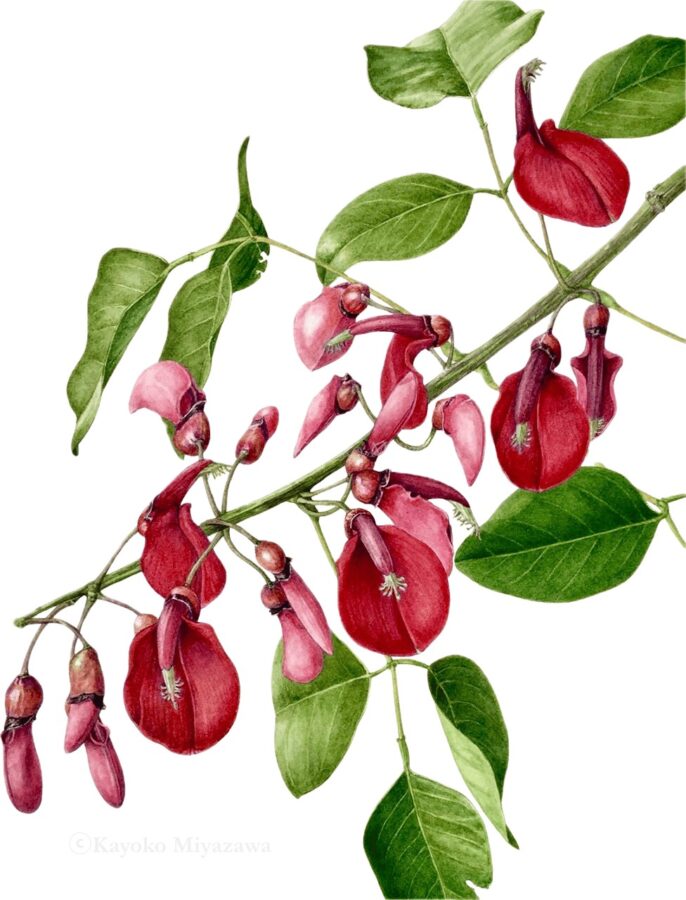
I strongly encourage painting only after absorbing information about the plant through every sense available to us as human beings.
Every single plant on display at a flower shop has its own story. Which continent does it originate from? What kind of climate does it grow in? Who gave it its name? I believe that knowing even just one piece of that background before you begin to paint is an important process — one that adds depth to your expression.
Each and every flower is, in a sense, like a sphere. Rather than seeing it as simply “round,” imagine what world lies on its other side.
To paint a picture in which you can see the “other side” of the sphere. That, I feel, is close to the very essence of translating three dimensions into two. And it is the vision of botanical art that I strive towards.
ⓒKayoko Miyazawa