
Botanical art is not simply about creating beautiful paintings of plants.
The time spent observing a single plant, studying its form, color, and texture, and carefully translating its character onto paper is a creative practice that quietly nourishes both the mind and the body.
Observation and Drawing Engage the Brain
Botanical art requires careful observation, an understanding of composition and balance, the ability to plan a work from start to finish, and precise hand movements.
The process of observing, thinking, making decisions, and drawing naturally engages many different areas of the brain.
At the same time, the act of drawing itself encourages a calm and focused state of attention, offering a welcome pause from the demands of everyday life.
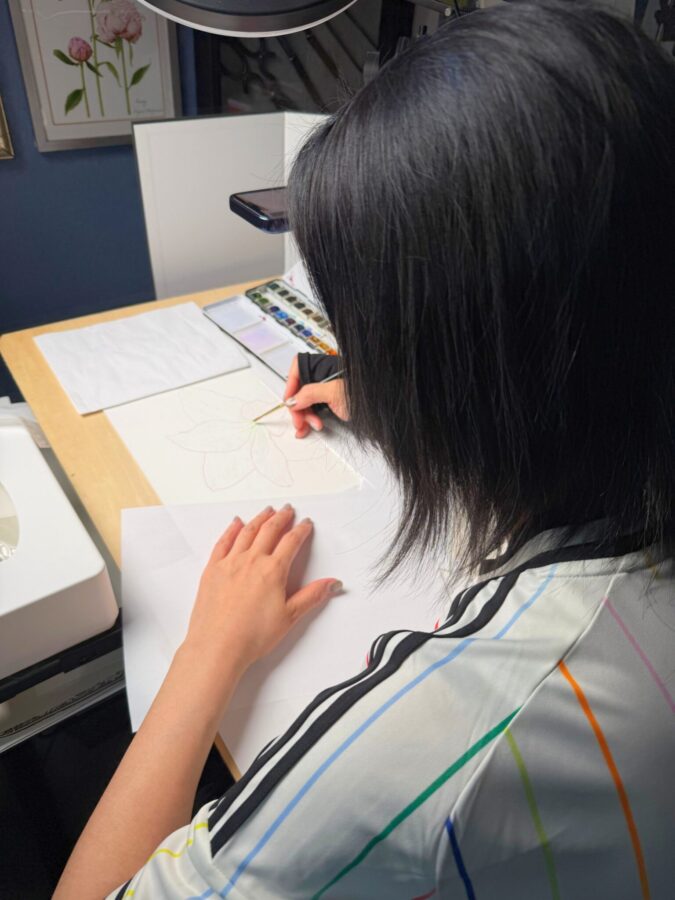
Deep Concentration Through Connection with Plants
As you observe the details of a plant, draw each line, and gradually build layers of color, it is easy to lose track of time.
Many people experience this sense of complete absorption while working.
This state of deep focus is often described as “flow,” a condition that allows the mind to step away from daily distractions and settle into a quieter rhythm.
Focusing fully on the plant before you and becoming immersed in the present moment also shares qualities with what is often described as mindfulness.
Simply taking the time to observe a plant closely can provide an opportunity to reconnect with your senses and slow the pace of a busy life.
Seeking Plants Means Connecting with Nature
Visiting botanical gardens, exploring seasonal flowers, and searching for suitable subjects are all important parts of the botanical art process.
Walking among plants, feeling the light and the air, and noticing the changing seasons become more than research.
They become a meaningful dialogue with nature itself.
Learning to See Plants Differently
Over time, botanical art changes the way we see plants.
We begin to notice the unique shape of each petal, the intricate patterns of leaf veins, and the quiet beauty found in buds, seed pods, and stems.
As our awareness grows, we become more attuned to seasonal change and the subtle rhythms of the natural world.
To see plants differently is, in many ways, to see the world differently.
Botanical art is not only about learning the skills to draw plants accurately; it is also about cultivating a deeper appreciation for the beauty that surrounds us.
Botanical Art as a Quiet Practice for Well-Being
Botanical art is an art form that does not demand haste or competition. Instead, it invites us to work at the pace of nature.
The time spent observing, drawing, and engaging with plants naturally encourages calmness, focus, and heightened awareness.
Completing a botanical painting is about more than producing a finished work.
It is also a way of spending meaningful time with both nature and oneself.
Perhaps the true value of botanical art is that improving our well-being is not the goal. Rather, it is something that gently follows as a result of the process.
ⓒKayoko Miyazawa