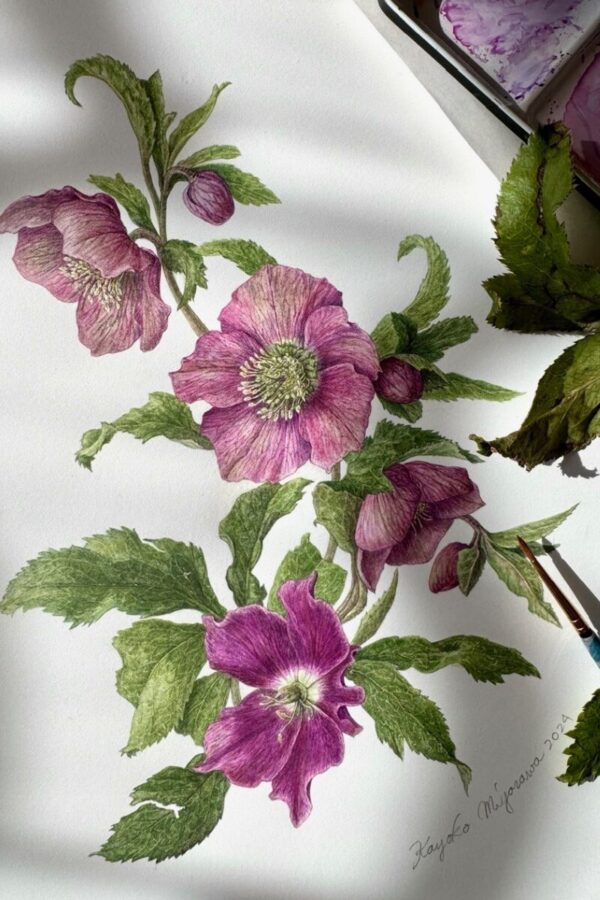
構図は、パッと決まることもあれば、自分のイメージに近づけるために、かなり時間をかけて工夫することもあります。植物を見た瞬間に閃いたイメージがあっても、それがボタニカルアートとして学術的に合っているかどうかも考えなければなりません。
「ここに葉っぱがあってはいけないな」などと考えながら、思わずひとりで笑ってしまうこともあります。以前、彼岸花を描いたときは、三日間悩んだ末に描き始めたものの、どうしても何かが違うと感じて、途中で筆を置いてしまったこともありました。そういう時は、いったん頭を空っぽにしてから、また改めて向き合うようにしています。それほどまでに、私は「構図」が重要だと感じています。
華(はな)を編み、風を描く
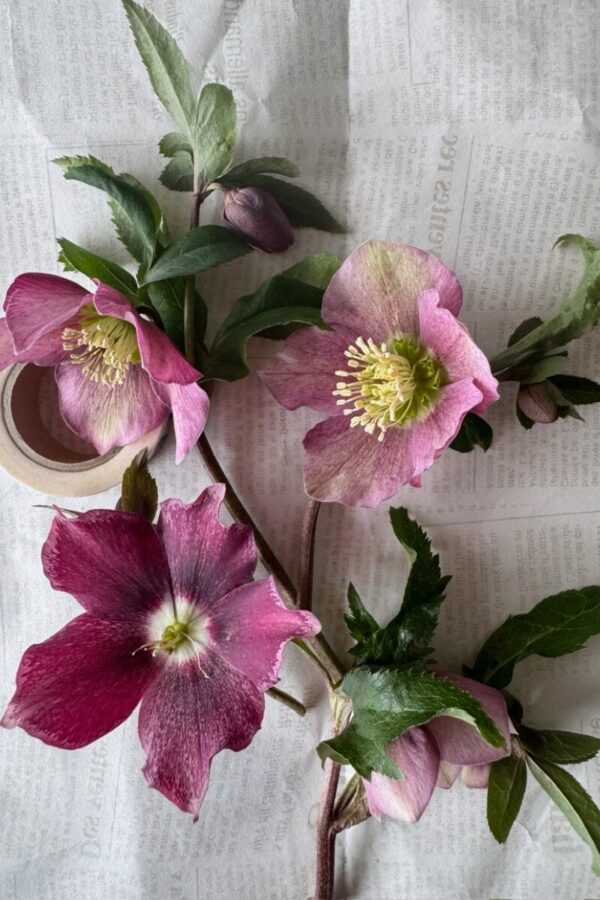
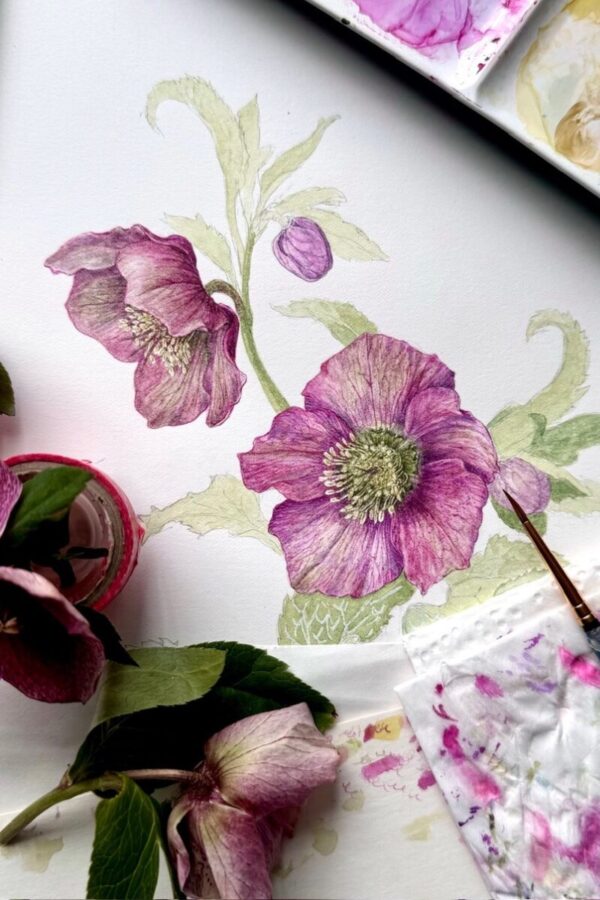
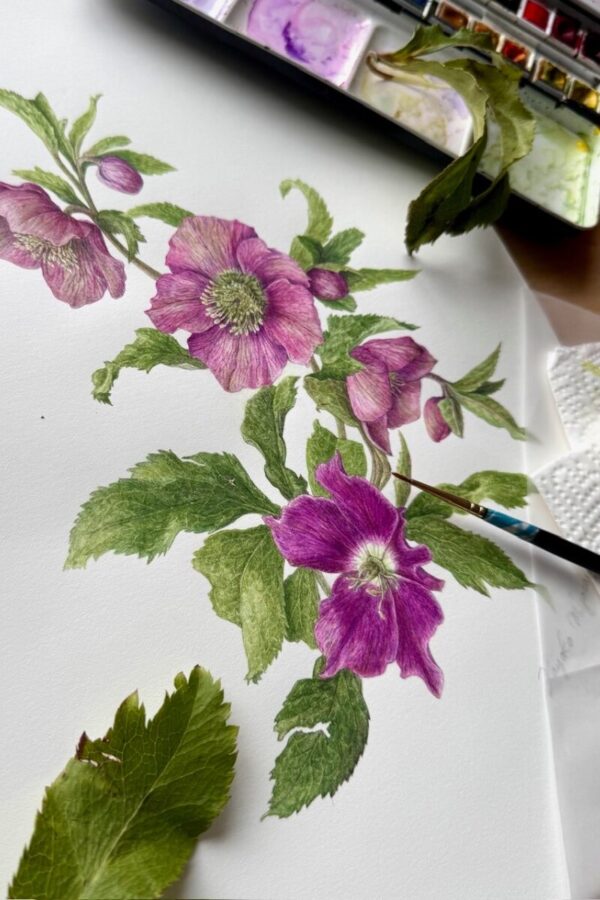
植物は思い思いの方向へ、主に太陽に向かって伸びていきます。その姿を、地面に生えているままの状態で画用紙の四角い枠の中に収めることはできません。
これは、モデルさんに例えると分かりやすいかもしれません。きちんと化粧をして服を着せ、ポーズをとってもらうことで初めて「絵」になります。どんなに美しいモデルさんでも、すっぴんでだらしない格好のままでは作品にならないのと同じです。
切花であっても、花には必ず「正面」があります。一本描くだけでも、茎の線ひとつで絵の印象は大きく変わります。たくさんの茎や花を描く場合は、一本の鉛筆の線がより重要になってきます。線の曲げ方ひとつで、まったく違う世界になってしまうからです。
華道の記憶と線の「機微」
これは華道にも通じることかもしれません。私はガラス作家だった頃、花器を作るために草月流を習っていました。花を生ける器は、器だけが良くても、花だけが良くても美しくはなりません。一体となったときに、互いの良さを引き出してこそ完成するものだと学びました。その経験は、今の制作にも確実に息づいています。
ボタニカルアートは「見たままを描く」とよく言われますが、それはもちろん大切なことです。けれど私は、そこに空気や風、揺れ、そして匂いまで伝わるような絵を描きたい。そのためには、線ひとつ、配置ひとつが妥協できない要素となります。
道端の植物を見ながら、「この子にはどんな構図が合いそうかな」と考えつつ、愛犬の散歩をしていることもよくあります。線に妥協せず、たとえ花がうまく描けたとしても、配置や葉っぱを含めてすべてが一つの物語になる。そうして積み重ねた先に、自分だけのオリジナリティが生まれてくるのだと、私は確信しています。
宮澤 香代子

The Resonance Within a Line
Composition is an evolving journey. Sometimes it strikes me in a heartbeat; other times, it requires hours of deliberate refinement to mirror the image in my mind. Even when an inspiration feels perfect, I must cross-reference it with botanical accuracy. I often find myself smiling in a solitary debate with the paper: “No, a leaf shouldn’t grow from this angle.”
I once spent three days agonizing over the layout for a Lycoris (Red Spider Lily) painting, only to stop halfway through because it didn’t feel “right.” In those moments, I have to clear my mind and start fresh. That is the weight I place on composition.


Weaving Flowers, Painting the Breeze
In the wild, plants reach toward the sun in a beautiful, chaotic tangle. You cannot simply transplant that raw state into the rectangular frame of a drawing sheet.
Think of it as working with a fashion model. A model only becomes the subject of a masterpiece once they are styled, dressed, and posed. No matter how naturally beautiful they are, art requires preparation. Flowers are no different; even a single cut flower has a “face.” The curve of a stem can shift the entire mood of a piece, and when multiple elements are involved, every pencil stroke carries immense responsibility. A single degree of change in a line can create a completely different world.
Memories of Ikebana and the Nuances of a Line

This philosophy is deeply rooted in my past experience with Ikebana. During my years as a glass artist, I studied the Sogetsu school of floral arrangement to better understand the relationship between a vessel and its contents. I learned that neither the vase nor the flower is the protagonist alone—art is born when they harmonize to bring out the best in each other.
While botanical art is often defined as “painting what you see,” I strive for something more. I want to capture the intangible: the air, the breeze, the subtle swaying of a stem, and even the scent.
Whether I am walking my dog or observing roadside weeds, I am constantly searching for the perfect “pose” for each plant. I believe that when we refuse to compromise on a single line—when the placement, the leaves, and the flowers finally merge into one cohesive vision—that is where true originality resides.
Kayoko Miyazawa