
— Japanese vs. Western Holly : The Differences and the Secret of the Thorns
In Japan, when people hear the word “Hiiragi” (Holly), they tend to lump English Holly and Western Holly together as the same thing. However, Japanese Hiiragi and Western Holly are actually entirely different plants.
The so-called Japanese Hiiragi belongs to the Oleaceae (Olive) family, the same as the fragrant olive (Kinmokusei), and it bears blackish berries. On the other hand, Western Holly (such as English Holly) belongs to the Aquifoliaceae family. They differ even at the family level and are completely distinct species.
In Japan, it has long been believed that planting Hiiragi in the front “demon’s gate” (the northeast) and Nanten (Sacred Bamboo) in the back “demon’s gate” (the southwest) of a house brings good luck. This is known as Kimon-yoke, or protection against evil spirits. There is also a custom seen nationwide called “Hiiragi Iwashi,” where a sardine head is stuck onto a branch of Hiiragi and displayed at the entrance on the night of Setsubun (the day before the beginning of spring). The proverb “Even the head of a sardine can be a god if you have faith” (meaning belief is everything) comes from this tradition.
To be honest, I actually encountered this sight at an apartment where I lived when I was a student. A dried-up fish impaled on a branch of Hiiragi was attached to the front staircase. Every time I saw it, I was genuinely scared… I assumed it was some strange cult or black magic, and I unconsciously avoided the people living in that unit. It wasn’t until much later that I learned the meaning of this custom. Thinking back now, I realized I had been very rude to my neighbor. 😓
Botanically, the method of distinguishing them is actually quite clear. Japanese Hiiragi leaves grow “opposite” (in pairs), whereas Western Holly leaves grow “alternate” (staggered). You can identify them just by this difference alone.
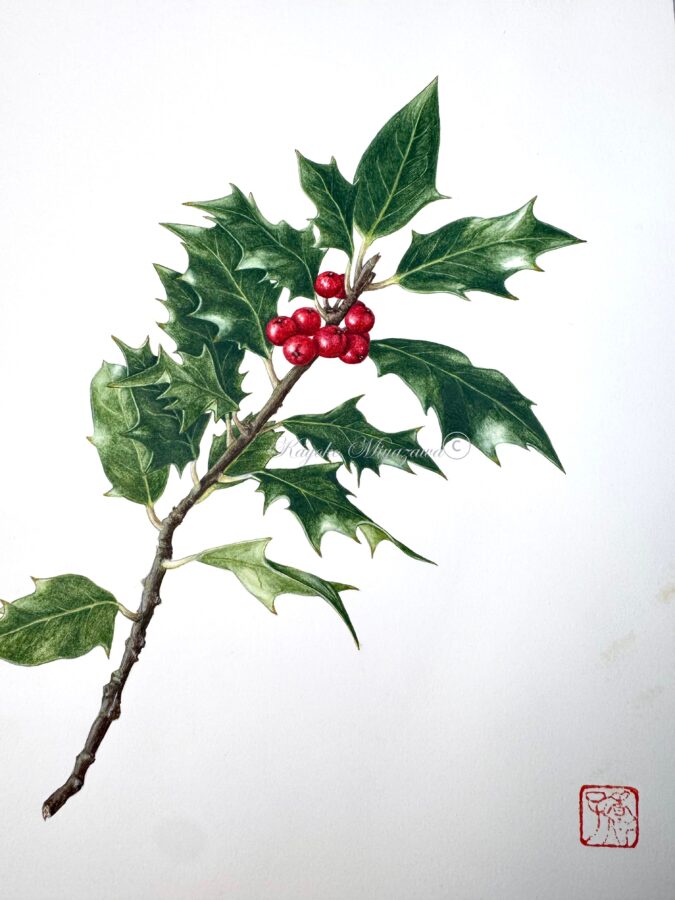
When we think of English Holly, those sharp, jagged leaves make a strong impression; it is a truly beautiful plant. However, in Japan—or at least in Tokyo—we rarely see that typical variety. I wonder if they exist in Hokkaido, where the latitude is closer to Europe… I’m a little curious.
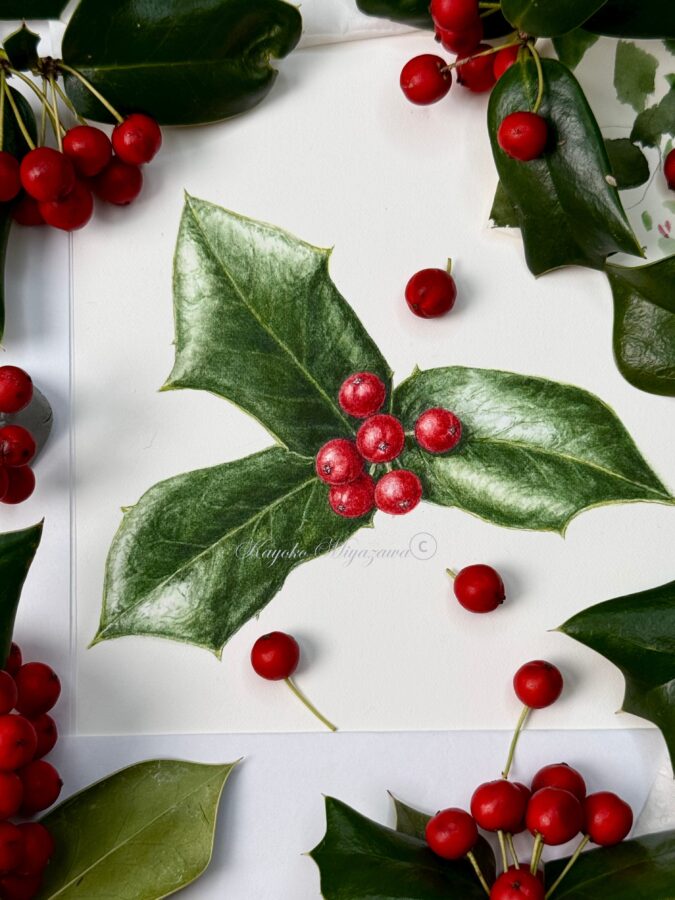
Most of the holly available in the Tokyo area is Western Holly, but the leaves tend to be rounder with more modest spines.
The holly I drew this time is also Western Holly. While observing it, I noticed something: the leaves near the bottom have many thorns, but the higher up the plant you go, the rounder the leaves become, with fewer thorns. When I looked it up, I learned that the lower leaves develop thorns as a defense mechanism because they are easily eaten by insects, while the upper leaves, which are harder for insects to reach, tend not to grow thorns.
What a fascinating phenomenon. Plants have evolved in this way, adapting to their environment.
The more I learn, the more attractive plants become as subjects to draw.
©Kayoko Miyazawa