
Botanical art deliberately leaves the background undrawn. This comes from its roots as scientific illustration.
The white of the paper is left untouched — what we call “negative space” (yohaku, or “margin,” in Japanese).
At first glance, this blank space looks like nothing at all. But it actually plays a vital role. That’s exactly why I want to make this negative space as dramatic as possible.
Of course, even when the negative space is generous, the focal point never shifts. I think carefully about where the viewer’s eye will travel, and balance that against the surrounding space. This creates a sense of depth and air within the piece — sometimes even a feeling of wind or fragrance drifting through it. Negative space has the power to draw out a plant’s true beauty.
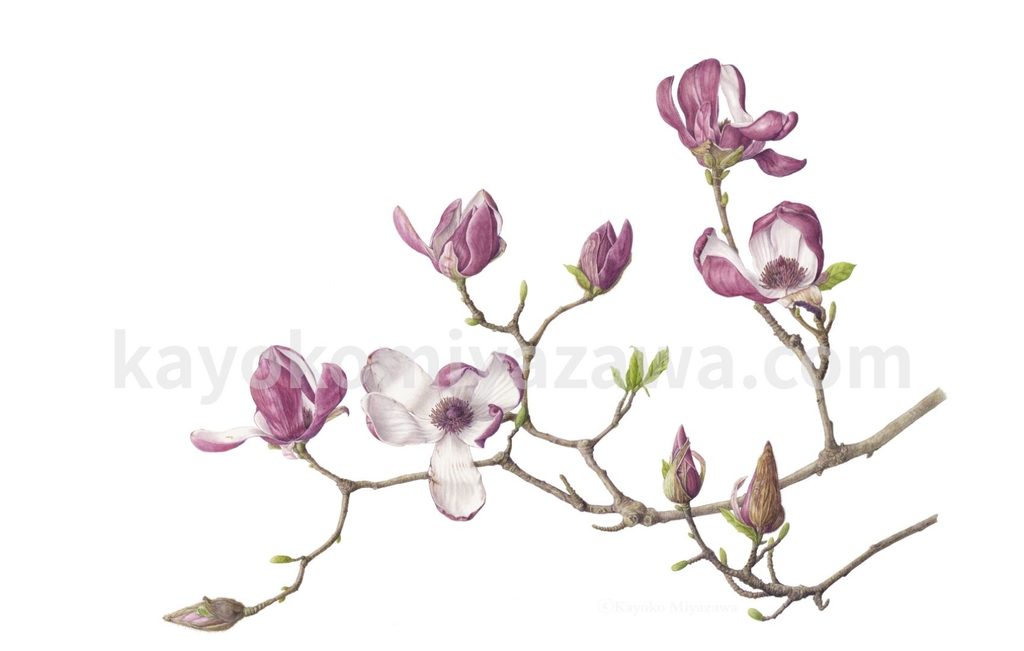
In Japanese, there are expressions like “reading the space between” and “reading the air.” There’s also a cultural sensitivity, much like wabi-sabi, to the quiet beauty found in emptiness. It’s because this sensibility runs through us that I want to hold onto negative space in botanical art as well.
Negative space also has the power to spark imagination. When part of an image is left undrawn, the viewer’s mind naturally fills in what lies beyond it.
Think of someone wearing a mask. We unconsciously imagine the face hidden beneath it. And when we finally see that face without the mask, we often think, “That’s not quite what I pictured.” That’s how much we imagine and complete what we cannot see.
The white negative space in botanical art works the very same way. Though nothing is drawn there, it opens up a space for each viewer’s own imagination.
That’s why I treasure this white negative space so deeply. I believe it’s an irreplaceable space — one that brings out the true beauty of the plant.
ⓒKayoko Miyazawa